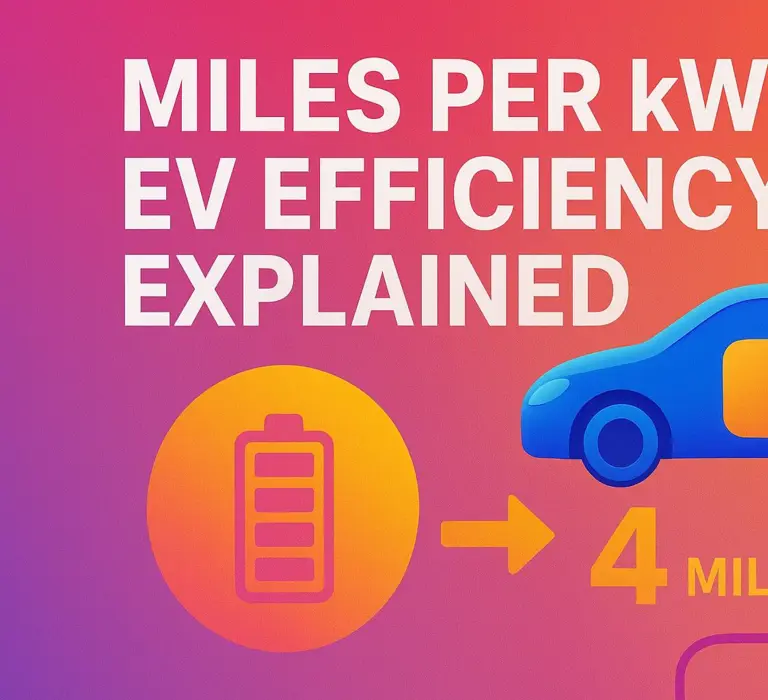
Miles per kWh is one of the most important numbers to understand when driving or choosing an electric car. It tells you how far an EV can travel using one unit of electricity.
If you’ve ever asked how many miles does 1 kWh get you, what is a good miles per kWh, or whether one EV is more efficient than another, this number is the answer.
This guide explains what miles per kWh means, how many miles you can expect in real UK driving, what counts as good efficiency, and how different electric cars compare.
What Does Miles per kWh Mean?
Miles per kWh (miles per kilowatt-hour) measures how efficiently an electric car uses energy.
1 kWh is a unit of electricity. If an EV achieves 4 miles per kWh, it means the car can travel four miles using one unit of electricity.
It is the electric car equivalent of miles per gallon. The higher the miles per kWh, the more efficient the car and the lower the running cost.
Looking to Lease a Electric Car? Get Exclusive Deals and Offers Today!
How Many Miles Does 1 kWh Get You?
For most modern electric cars on UK roads in 2026, 1 kWh gives you between 3.5 and 4.5 miles in real-world driving.
Typical real-world figures:
-
Around 3.2 mi/kWh: larger SUVs and high-performance models
-
Around 4.2 mi/kWh: efficient mid-size EVs (standard for 2026)
-
5.5 mi/kWh or more: ultra-efficient or city-focused models
So if your car is averaging 4.2 miles per kWh, a 60 kWh battery would give roughly 252 miles of usable range in mixed UK driving.
What Is a Good Miles per kWh?
Here is a simple UK guide for 2026 efficiency standards:
-
3.5 mi/kWh Normal for heavier EVs, large SUVs, and sustained motorway driving.
-
4.5 mi/kWh Good efficiency for most modern electric cars and hatchbacks.
-
5.5+ mi/kWh Excellent efficiency, typically seen in highly aerodynamic or lightweight models.
In everyday UK use, anything consistently above 4.2 mi/kWh is considered very efficient.
Average Miles per kWh in the UK
Across the current UK EV market, the real-world average now sits between 3.8 and 4.3 miles per kWh.
This is affected by:
-
driving speed
-
temperature and winter use
-
town vs motorway driving
-
wheel size and vehicle weight
Cold weather in a UK can reduce miles per kWh by 15 to 25 percent, though most 2026 models now use advanced heat pumps to minimize this drop.
Miles per kWh vs kWh per Mile
Some cars and apps display kWh per mile instead. They show the same information, just in reverse.
-
Miles per kWh: higher is better
-
kWh per mile: lower is better
Example: 4 miles per kWh = 0.25 kWh per mile Both figures describe the same efficiency.
How to Work Out Miles per kWh
The calculation remains the same: Miles driven ÷ electricity used (kWh) = miles per kWh
Example: If you drive 126 miles and use 30 kWh: 126 ÷ 30 = 4.2 miles per kWh
Most EVs show this automatically on the dashboard or in their mobile apps.
Electric Cars With Strong Miles per kWh
Typical real-world efficiency ranges for popular 2026 models:
-
Tesla Model 3 RWD (Refreshed): around 4.5 to 5.0 mi/kWh
-
Hyundai Ioniq 6: often between 4.8 to 5.3 mi/kWh
-
MG4 EV: around 3.8 to 4.2 mi/kWh
-
Kia EV3: around 4.2 to 4.6 mi/kWh
-
Nissan Leaf: around 3.0 to 3.5 mi/kWh
These models are popular because they deliver strong real-world efficiency without needing excessively heavy batteries.
How Miles per kWh Affects Running Costs
Miles per kWh directly controls how much each mile costs.
Example using 2026 UK home charging rates:
-
Standard Variable Rate (Ofgem Cap): ~£0.28 per kWh
-
Efficiency: 4 mi/kWh
-
Cost per mile = about 7p
However, most UK drivers now use EV-specific tariffs with off-peak rates (e.g., £0.07 per kWh). On these tariffs, the cost at 4 mi/kWh drops to just 1.75p per mile.
This is why efficiency matters just as much as battery size. When comparing electric cars or car leasing options, a smaller battery with high miles per kWh is often significantly cheaper to run than a larger, less efficient model.
You can also try our Fuel Cost Calculator UK to compare your EV costs against petrol and diesel cars.
Why Miles per kWh Matters When Choosing an EV
Higher miles per kWh means:
-
lower charging costs
-
more real-world range from the same battery
-
less dependence on expensive public rapid chargers
-
better winter usability
This is particularly important for drivers considering electric car leasing, where real running costs and usable range shape day-to-day ownership.
How to Improve Your Miles per kWh
-
Keep speeds steady (motorway speed is the biggest "range killer")
-
Avoid hard acceleration
-
Maintain correct tyre pressures
-
Remove unnecessary weight
-
Preheat the car while plugged in (using the app)
-
Expect lower figures in winter
Small changes can improve efficiency more than many people expect.
Key Takeaway
Miles per kWh is the clearest way to judge how efficiently an electric car uses energy. In the UK, most modern EVs achieve between 3.8 and 4.3 miles per kWh, while anything above 4.5 is considered very efficient. The higher the number, the lower your cost per mile and the more usable range you get from each charge.
FAQs About Miles per kWh
In 2026 UK driving, around 4.5 mi/kWh is considered good. Above 5.5 mi/kWh is excellent.
Most electric cars travel around 3.8 to 4.3 miles per kWh in real-world use.
Most drivers see around 4.5 to 5.0 miles per kWh in the latest RWD models.
3.5 mi/kWh is average for larger SUVs and motorway driving, but modern hatchbacks and saloons should aim for higher.
Speed is the primary factor, followed by outside temperature, tyre pressure, and driving style.